



Lachha paratha production line
设备参数EQUIPMENT PARAMETERS
设备产能/EQUIPMENT CAPACITY 5500-8600PCS/H
设备尺寸/EQUIPMENT DIMENSION 31118mm(L)*1550mm(W)*1648mm(H)
电力规格/POWER SPECIFICATIONS 3PH 380V 50HZ 21KW
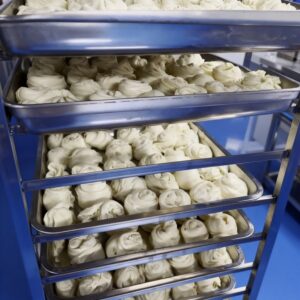
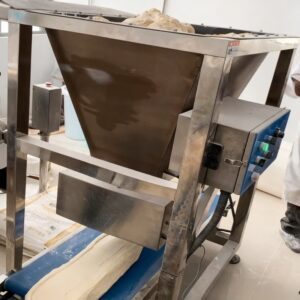
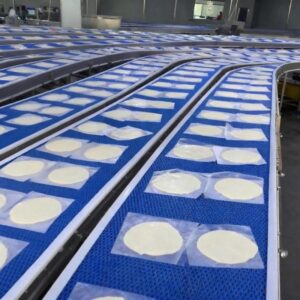
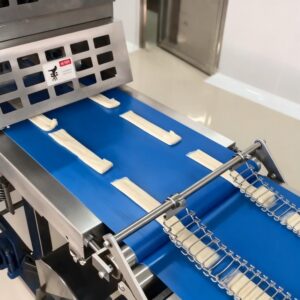
Production Process
Stage 1: Dough Dividing & Feeding
Pre‑mixed dough is loaded into a dough divider. Uniform portions travel up an inclined conveyor to the sheeting section.
Stage 2: Multi‑Stage Sheeting
The dough passes through several sets of sheeting rollers, gradually reduced to a thin, uniform sheet.
Stage 3: Oil Brushing & Scallion Sprinkling (Optional)
A dual‑sided oil applicator brushes oil onto the dough sheet. An automatic scallion dispenser evenly sprinkles chopped green onions across the surface – density PLC‑adjustable.
Stage 4: Automatic Rolling into Logs
The oiled (and scallion‑covered) dough sheet passes through an automatic rolling structure that gently curls the sheet into a tight, continuous dough log. This mechanical curling replaces manual rolling, ensuring uniform density and layer integrity.
Stage 5: Multi – Tier Relaxation (One Relaxation)
The dough logs enter a multi‑tier relaxation conveyor. This provides several minutes of controlled rest, allowing gluten to relax after rolling – reducing spring‑back and preventing shrinkage during later pressing.
Stage 6: Portioning (Cutting or Coiling)
The relaxed dough logs are cut or coiled into individual dough portions of precise weight – ready for pressing.
Stage 7: Pressing
The portions are conveyed to a high‑precision pressing machine. An optional film applicator places protective plastic film above and below each piece. The press flattens each portion into a uniform disc.
Key Advantages
1. Automatic Rolling Structure – Consistent Log Formation
The dedicated mechanical rolling unit curls the dough sheet into tight logs – eliminating manual rolling and ensuring uniform density.
2. Relaxation After Rolling – Prevents Shrinkage
The multi‑tier conveyor provides a short, controlled rest after the dough is rolled into logs. This allows gluten to relax, reducing spring‑back and shrinkage during pressing.
Frequently Asked Questions
Q: What is the correct process order for rolling and relaxation?
First, the dough sheet is automatically rolled into logs. Then the logs pass through a multi‑tier relaxation conveyor. After relaxation, the logs are portioned and pressed. This order ensures the gluten relaxes after being stressed by rolling, minimizing shrinkage.
Q: Is this line fully automatic?
No, it is semi‑automated. Operators load dough, refill scallions, and monitor output, but the core forming steps (sheeting, oiling, scallion sprinkling, rolling into logs, relaxation, portioning, pressing) are automatic.
Q: Can this line produce plain paratha (no scallions)?
Yes. Simply turn off the scallion dispenser via the PLC.
Q: What types of scallions can the dispenser handle?
Fresh chopped, IQF frozen slices, spring onion rings, or dehydrated flakes.
Q: Do you provide after‑sales support?
Yes. On‑site installation, commissioning, training, spare parts, and remote diagnostics.
